
Constructed Nature
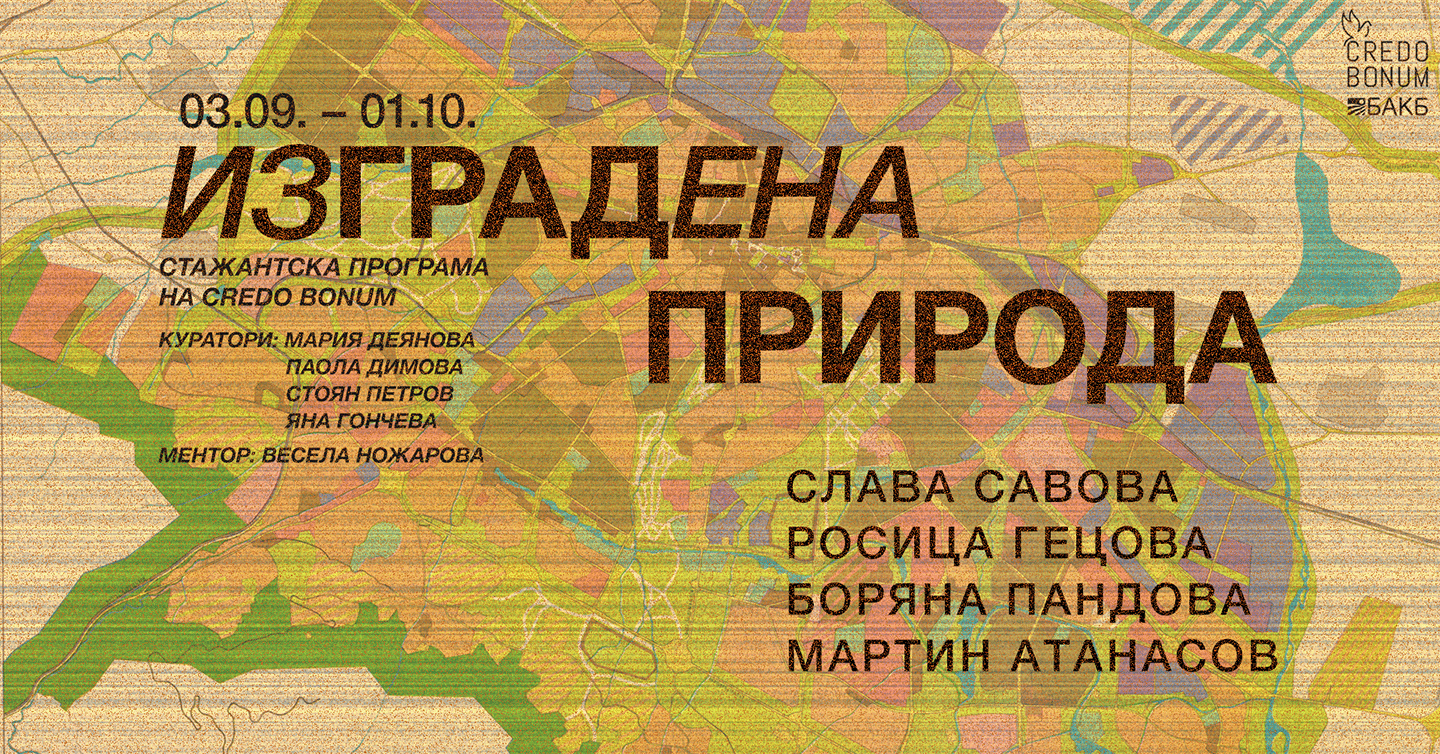
Constructed Nature
Opening: 3 September, 18:00
Credo Bonum Gallery
Featuring works by Boryana Pandova, Martin Atanasov, Rositsa Getsova and Slava Savova
The city is often perceived as a space from which nature has been pushed out—as though nature were that which exists elsewhere, apart from humans. What, then, are the water in our taps, the meat we consume, the weeds growing between broken paving slabs and urban parks to us?
The exhibition examines where our idea of a boundary between “city” and “nature” comes from and how it participates in the production of material boundaries.
A boundary both separates and creates two distinct entities. The city and nature are not simply two pre-existing things between which we subsequently draw a line; the very act of opposing them helps produce them as dialectically related concepts.
Different distinctions are often superimposed on one another—the urban aligned with the artificial and the controlled, and what lies beyond the city with the natural and the wild—even though these categories do not always coincide materially. The modern conception of “the wild” has been shaped as a space outside civilisation, placing the human and the natural at opposite poles. Nature easily comes to be understood as that which exists elsewhere, apart from humans. But why must “true” nature be far from the city? If nature is what lies outside the city, how do we perceive the plants, animals, water and atmospheric processes within it? As remnants of nature? Decoration? Infrastructure? Something out of place? Something to be controlled?
Human conceptions are a map we use to navigate the world. A general geographical map represents a territory’s spatial relationships, distances and topology. When linked to institutional power, maps participate in transforming that territory. A spatial plan is both a representation and a tool of governance. A boundary drawn on a spatial plan can lead to different building regulations. The delineation of a protected area determines permitted and prohibited activities, access and management. A cadastral boundary materialises as a fence.
The boundary between city and nature is produced—conceptually, historically, legally and materially—and although it is never entirely stable, its consequences are very real. Conceptual and material distinctions do not operate in only one direction: the way we define space influences how we transform it, while the transformed environment, in turn, shapes the categories through which we perceive it.
The exhibition is curated by Maria Deyanova, Paola Dimova, Stoyan Petrov and Yana Goncheva as part of Credo Bonum Gallery’s internship programme, under the mentorship of Vesela Nozharova.
The exhibition is realised with the financial support of the Bulgarian-American Credit Bank (BACB).


